Brand Visibility in AI Search: New Research, A New Era, and Why the Old Playbook Is Not Enough
Co-authors Valorie Luther, M.S. and Ofri Touboul-Cohen have produced the first longitudinal, cross-platform study of competing brand AI visibility within a single consumer category in the U.S. Here is what brand leaders need to understand about the shift from SEO to AI search.
Published: March 19, 2026 | 5 min read
Key Takeaway: Valorie Luther, M.S., Founder and Chief Strategist of Creative Concepts, and Ofri Touboul-Cohen, Co-Founder and CEO of Whitebox, have produced the first longitudinal, cross-platform study of competing brand AI visibility within a single consumer category. The research is currently under academic review and addresses a gap that has been building in the literature since AI-generated responses began reshaping how consumers find and evaluate brands.
If you have been in marketing long enough, you remember when SEO felt like cracking a code. Figure out what Google wanted, give it that, and your brand showed up. It was not effortless, but it was logical. You could see the levers, pull them, and measure what happened.
That clarity is harder to come by now. The introduction of ChatGPT in November 2022 and the rollout of Google AI Overviews in May 2024 did not just add new platforms to the mix. They changed the fundamental structure of how consumers find information. Instead of a ranked list of links, people increasingly receive a synthesized answer. And whether your brand appears in that answer, and how it is represented when it does, is governed by a different set of rules than the ones most marketing teams have spent years mastering.
Co-authors Valorie Luther, M.S. of Creative Concepts and Ofri Touboul-Cohen of Whitebox.io set out to study exactly that. Their research, now under academic review, is the first longitudinal study to track how competing brands actually appear in AI-generated responses within a single consumer category across multiple platforms over time. It matters because that specific question had not been formally studied before.
How Search Worked and Why It Made Sense
Search engine optimization developed its logic around how Google ranked pages: the quality and quantity of inbound links, the relevance of content to the query, and a growing list of technical signals. A brand that invested in understanding that system could predict, with reasonable confidence, where it would appear for a given search term.
The click-through rate data made the stakes concrete. Research from Backlinko found that the top organic result on a Google search captured roughly 28 to 36 percent of all clicks, with each position below capturing significantly less. Rank higher and you got traffic. Get traffic and you could convert it into customers. For 2 decades, that loop held.
SEO also had the advantage of being what researchers call platform-convergent. The signals that worked on Google translated reasonably well to other search engines. One coherent program could reach most of the search landscape. A single strategy, thoughtfully executed, was enough. That is no longer the case.
What Changed and How Quickly
The introduction of ChatGPT in November 2022 and Google AI Overviews in May 2024 replaced ranked lists with synthesized natural-language responses. Research from seoClarity and Seer Interactive found that organic click-through rates decline by as much as 61 percent for queries where AI Overviews are present. Bain and Company reported that roughly 80 percent of consumers now rely on zero-click results in at least 40 percent of their searches.
Pew Research put behavioral data behind those numbers. In a 2025 study tracking the browsing activity of 900 U.S. adults, users who encountered an AI-generated summary in Google search results clicked through to an external website only 8 percent of the time, compared to 15 percent when no summary appeared. 26 percent ended their session entirely after seeing the AI summary, without clicking anything. The search results page had become the destination.
For brands, the shift is not abstract. A consumer asking an AI platform for a product recommendation in any category is going to receive an answer, not a list of options to explore at their own pace. The question is whether your brand is in that answer, and what it says when it is.
Why AI Visibility Is Not Just SEO by Another Name
The instinct in most marketing organizations has been to treat AI visibility as an extension of SEO. If you rank well on Google, the assumption goes, you are probably showing up in AI-generated answers too. That assumption deserves more scrutiny than it has received.
A 2026 analysis by Punturo, Torres Llorca, and Fishkin examined 27 million citations across ChatGPT, Gemini, and Google AI Overviews and found substantial differences in how each platform constructs its answers. The sources AI platforms draw on are not simply the pages that rank highest in traditional search. The signals that govern whether a brand is included in an AI-generated response, and where it appears within that response, are not identical to the signals that determine search ranking.
The field of Generative Engine Optimization has emerged to address this. Foundational research established that optimization strategies developed for traditional search do not transfer cleanly to generative AI environments. Studies have shown that how brand content is framed influences whether large language models include a brand in their recommendations. Platform architecture, training data, and retrieval mechanisms differ enough between AI systems that the same brand can appear very differently depending on which platform a consumer happens to use.
What that body of work had not yet produced was a study of how actual competing brands show up in AI-generated results over time. The existing GEO research has largely relied on fictitious product catalogs and single-platform experiments. Valuable for establishing principles, but unable to answer the question a CMO is actually asking: where does my brand stand today, is it gaining or losing ground, and how does it compare to the competition?
The Research That Was Missing
That is the question Valorie Luther and Ofri Touboul-Cohen built their study around. Not a theoretical exercise about how AI systems work in principle, but an empirical one: within a real consumer category, across the platforms where real consumers are searching, how do competing brands actually appear, and does that change over time?
Their study examined a U.S. consumer category with established national brands competing across distinct market positions. It tracked AI visibility across multiple platforms and multiple measurement intervals. It is the first study of its kind in the published literature and is currently under academic review.
Luther brings expertise in AI visibility strategy, brand reputation, and academic research, including published work on neuromarketing ethics. Touboul-Cohen, as Co-Founder and CEO of Whitebox, brings the generative engine intelligence infrastructure that made systematic data collection at this scale possible. The collaboration is what allowed the study to meet academic standards while staying grounded in the practical measurement challenges brand teams actually face.
Frequently Asked Questions
What is AI visibility and why does it matter for brands?
AI visibility refers to whether and how a brand appears in the responses generated by AI platforms when consumers ask questions relevant to that brand's category. When a consumer asks ChatGPT or Google AI Overviews for a product recommendation and a brand does not appear in the answer, that brand is not ranked lower. It simply is not there. As consumer behavior shifts toward AI-generated answers, the practical consequences of that absence are growing.
Is AI visibility the same as SEO?
No, and the difference is more than technical. Traditional SEO is built around a ranked list of results where visibility is determined by position and click-through behavior is relatively predictable. AI-generated responses work differently. The platform constructs a natural language answer, selecting which brands to include, in what order, and with what framing. The signals that govern that process are not the same signals that govern search rankings, and a strategy built for one environment does not automatically serve the other.
What is Generative Engine Optimization?
Generative Engine Optimization, or GEO, is the emerging discipline focused on how brands can improve their visibility within AI-generated responses. Unlike traditional SEO, which targets ranked lists of links, GEO is concerned with whether a brand appears in the answer an AI platform constructs and how it is represented within that answer. The field is relatively young, and the peer-reviewed research needed to support real strategic decisions is still catching up to industry interest.
What happens next with this research?
The research is under academic review. Valorie Luther and Ofri Touboul-Cohen will share findings as they are cleared for public discussion. Updates will be published as they come.
The gap this research addresses is not just an academic one. Organizations making AI visibility decisions right now are largely doing so without a formal empirical foundation. They are borrowing frameworks from traditional search, making assumptions that have not been tested against real competitive data, and measuring performance with tools designed for a different information environment.
The brands that build real measurement capability now, before it becomes standard practice, will have an advantage that is difficult to close later. The question is not whether AI visibility matters. The behavioral data on click-through rates and zero-click search has already answered that. The more useful question is whether your organization understands where it stands in AI-generated results today, and whether that understanding is based on evidence or assumption.
Creative Concepts publishes ongoing analysis on AI visibility, brand strategy, and digital marketing through its Intelligence Briefings at creative-conceptsllc.com/intelligence-briefings.
The 7 Pillars of Modern PR and Why Most Brands Are Missing at Least Three
Modern PR requires seven distinct pillars from AI visibility to crisis management. Learn why most brands are falling short and how to build a complete PR strategy for 2026.
Published: February 25, 2026 | 5 min read
Key Takeaway: Public relations is no longer just a media relations function. It is a visibility, reputation, and discovery function as well that now determines whether your brand exists in AI-generated answers, survives a viral crisis, or gets recommended when no one types your brand name into a search bar.
The PR industry is projected to reach $129 billion by 2026. That number reflects something deeper than growth. It reflects a discipline that has fundamentally expanded in scope. The brands investing in public relations today are not simply trying to land a feature for a simple mention in Tier 1 outlets in addition to niche or trade publications. They are trying to ensure that when a consumer asks ChatGPT, Claude, Perplexity, or Google AI Overviews a question about their category, their name appears in the answer.
The connection is direct. Niche and trade publications feed a majority of the citations in AI engines as noted by Rand Fishkin in the SparkToro blog.
That shift changes everything about how PR is structured, staffed, and measured. A modern PR function requires seven distinct pillars working together. These are not theoretical. They are the actual areas where brand visibility, trust, and revenue are won or lost.
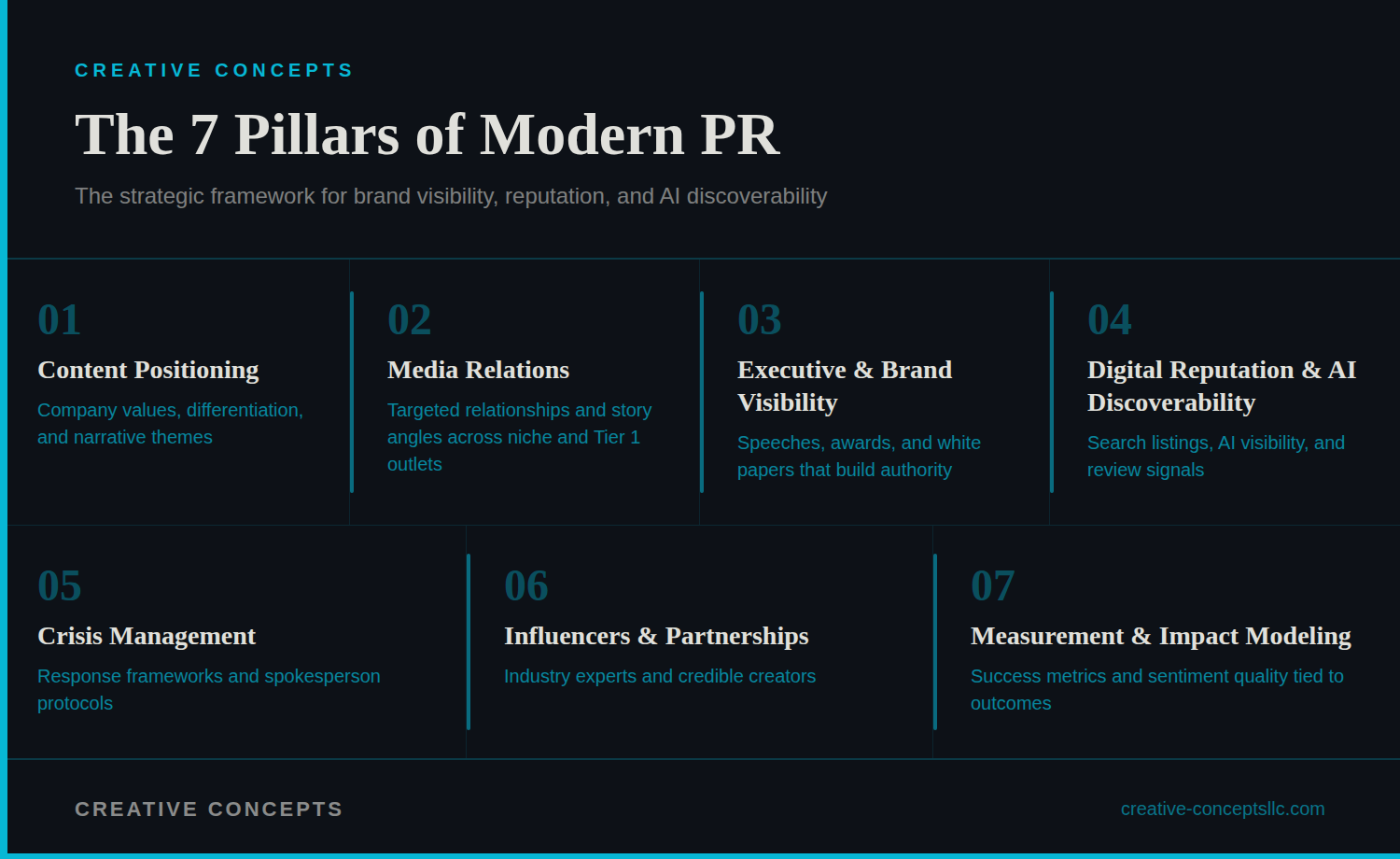
Creative Concepts, The 7 Pillars of Modern PR
What Are The 7 Pillars of Modern PR?
The seven pillars represent the full scope of what public relations must cover in 2026: content positioning, media relations, executive and brand visibility, digital reputation and AI discoverability, crisis management, influencers and partnerships, and measurement and impact modeling. Each pillar serves a distinct strategic function. Ignoring any one of them creates a gap that competitors will fill.
Pillar 1: Content Positioning
Content positioning is the foundation. It defines your company values, your differentiation, and your narrative themes before a single pitch goes out or a single post gets published. Without clear positioning, everything that follows is noise. The brands that show up consistently in AI-generated answers are the ones with a defined point of view that appears across multiple content types and platforms. Positioning is not a baseless exercise. It is the strategic backbone that determines whether your content gets cited or ignored.
Pillar 2: Media Relations
Media relations has not disappeared. It has become more targeted. A Seer Interactive analysis of 27 million AI-generated citations found that 97.4% of AI citations come from niche, trade, and specialist media. Only 2.6% come from Tier 1 outlets like Forbes or the Wall Street Journal. Both matter, but for different reasons. Niche media drives AI discovery. Tier 1 media validates credibility. A modern media strategy accounts for both tiers and builds pitch strategies accordingly. Building genuine relationships with journalists remains essential, especially as reporters now receive hundreds of AI-generated pitches weekly and can identify generic outreach immediately.
Pillar 3: Executive and Brand Visibility
The people behind a brand matter as much as the brand itself. Speeches, awards, white papers, and expert commentary build the kind of individual authority that AI engines evaluate when deciding who to cite. AI tools assess professionals the same way they assess brands. If your CEO or chief marketing officer has no published content, no speaking history, and no digital footprint beyond a LinkedIn profile, they are invisible to the systems that now shape public perception. Building executive visibility is not vanity. It is infrastructure.
Pillar 4: Digital Reputation and AI Discoverability
This is where the largest shift has occurred. AI visibility is a brand's ability to be accurately found and recommended by AI engines on platforms like ChatGPT, Perplexity, Claude, Gemini, and Google AI Overviews. SEO used to determine how brands were found online. AI visibility now determines whether brands are found at all.
The data is stark. When AI Overviews appear in a Google search, organic click-through rates drop by 61%. Around 93% of AI search sessions end without a website click. And only about 30% of brands remain visible in back-to-back AI responses for the same query. If AI does not cite your brand in an unbranded prompt, your product will not be considered. This is not a future scenario. It is the current operating environment.
The brands treating AI discoverability as an afterthought are already losing ground. Auditing how your brand appears in AI-generated responses, identifying where citations are missing, and building the authority signals that earn those citations is now a core PR function, not an optional add-on.
Pillar 5: Crisis Management
Viral content spreads in hours, not days. By the time traditional monitoring flags a threat, 54% of consumers have already formed a negative opinion about the brand in question. The response window that PR teams used to rely on has essentially collapsed.
Traditional monitoring tools fail because they rely on keyword matching, which misses euphemisms, coded language, and evolving slang. They deliver reports on weekly or monthly cycles, well after the damage window has closed. And they track volume and mentions without analyzing audience intent to boycott, switch, or take action.
That gap between when a threat emerges and when most brands respond is exactly what modern crisis tools need to close. AI BRAND DEFENSE™ by Creative Concepts was designed around this reality, using semantic and intent analysis to deliver counter-narrative guidance while the window to act is still open. Without that kind of speed, narratives harden into lasting reputation and revenue damage within 24 to 72 hours.
Pillar 6: Influencers and Partnerships
The influencer landscape has matured. The most effective partnerships in 2026 are not built on follower counts. They are built on credibility. Industry experts and subject-matter creators drive trust in ways that celebrity endorsements cannot replicate. Brands are moving from volume-based influencer strategies to value-based ones, partnering with creators who spark meaningful conversations and reflect shared values. PR professionals who understand how to identify and activate these partnerships create durable authority that feeds both human audiences and AI engines.
Pillar 7: Measurement and Impact Modeling
If you cannot prove the business impact of your PR program, you cannot defend the budget. That has always been true, but the metrics have changed. Success metrics now include share of AI-generated responses, citation frequency across AI platforms, sentiment quality, and the correlation between earned media placements and downstream revenue. 96% of communications teams now rely on data over intuition for decision-making. The PR function that cannot quantify its contribution to brand discovery, reputation defense, and pipeline influence will lose resources to functions that can.
How Do These Pillars Work Together?
No single pillar operates in isolation. Content positioning informs media relations. Media placements build the digital authority that AI engines use to determine citations. Crisis readiness protects the reputation that executive visibility and partnerships have built. And measurement ties every effort back to outcomes that matter to the C-suite. The brands that treat PR as a collection of disconnected tactics will continue to lose ground to competitors who treat it as an integrated system.
Frequently Asked Questions
What is AI visibility in public relations?
AI visibility refers to a brand's ability to be accurately found, cited, and recommended by AI-powered platforms like ChatGPT, Perplexity, Gemini, and Google AI Overviews. It is now a core function of modern PR strategy.
Why does niche media matter more for AI discovery?
Research shows that 97.4% of AI citations come from niche, trade, and specialist publications. These outlets provide the detailed, category-specific content that large language models prioritize when generating answers.
What is AI BRAND DEFENSE™?
AI BRAND DEFENSE™ is a proprietary crisis intelligence tool developed by Creative Concepts that monitors emerging threats using semantic and intent analysis, then delivers counter-narrative guidance within hours so brands can respond before a narrative becomes permanent.
How has crisis management changed in 2026?
The response window has collapsed from days to hours. Traditional keyword-based monitoring misses coded language and evolving slang. Modern crisis management requires real-time semantic monitoring and immediate counter-narrative strategy.
How should brands measure PR success in 2026?
Beyond traditional media impressions, brands should track share of AI-generated responses, citation frequency across AI platforms, sentiment quality, and the connection between earned media and business outcomes like revenue and customer acquisition.
Creative Concepts has operated at the intersection of digital marketing, brand strategy, and emerging technology for over 23 years. As AI reshapes how consumers discover and evaluate brands, these seven pillars provide the framework for PR programs that actually protect and grow market position.
Creative Concepts publishes ongoing analysis on AI visibility, crisis intelligence, and brand strategy through its Intelligence Briefings.
Sources:
Seer Interactive, AI citation analysis across ChatGPT, Perplexity, and Gemini
Conductor 2026 AI Search Benchmarks: https://www.conductor.com
PRLab, PR Industry Statistics 2026
Superlines, AI Search Statistics 2026
PR Week, How AI Will Change PR in 2026
Creative Concepts analysis of viral consumer brand threats, 2026
Defending Your Brand in the Misinformation Age: Introducing AI BRAND DEFENSE™
AI BRAND DEFENSE delivers viral misinformation intelligence within 24 hours at up to 60% less than traditional monitoring. Learn how Creative Concepts protects consumer brands before damage spreads.
Published: February 19, 2026 | 4 min read
Key Takeaway: AI BRAND DEFENSE™ is a new crisis management tool built to help brands understand the effects of online misinformation campaigns. The service is able to uncover real consumer sentiment, extract patterns of concern, and surface intent signals so companies can respond with clarity, accuracy, and confidence. While traditional monitoring takes weeks and costs $4,000-$6,000 monthly, Creative Concepts delivers suggested counter-messaging guidance within 24 hours at up to 60% less cost, enabling brands to respond during the critical viral window when public perception can still be influenced.
The digital landscape has shifted dramatically for consumer brands. A single misleading video can destroy years of brand equity before conventional monitoring systems detect the threat. Recent research examining comments from one viral YouTube video targeting a consumer brand showed 54% of critical commenters immediately disposed of products, switched brands, or demanded refunds. This immediate consumer action demonstrates why traditional crisis management approaches no longer match the speed of modern threats. AI BRAND DEFENSE is the time and revenue protection for brands operating in an environment where viral misinformation represents an existential threat.
What Prompted Creative Concepts To Launch AI BRAND DEFENSE™?
The speed gap between how fast misinformation spreads and how slowly traditional monitoring responds is not a technical limitation. It is a structural one. Most crisis tools were built for a media environment that no longer exists where threats moved at the pace of news cycles rather than social algorithms.
"Viral misinformation does not follow a business calendar," said Valorie Luther, Founder of Creative Concepts. "Trust erodes through the layered depth of online misinformation campaigns, often before traditional monitoring recognizes its full impact. AI BRAND DEFENSE was built to surface that depth and equip leaders with the intelligence to intervene before brand credibility is undermined."
AI BRAND DEFENSE was built specifically for this gap, delivering intelligence within the window where intervention still matters.
What is AI BRAND DEFENSE™?
AI BRAND DEFENSE is Creative Concepts' solution for combating viral misinformation campaigns that target consumer brands. This service delivers enterprise-grade semantic analysis and actionable counter-narratives within 24 hours at costs up to 60% below traditional monitoring services.
Why Does Speed Matter in Modern Brand Crises?
Contemporary brand crises unfold across three distinct phases:
Viral emergence happens within 0-6 hours as content spreads across platforms
Narrative crystallization occurs during hours 6-24 when specific attack themes solidify
Market impact follows in hours 24-72 when consumer behavior changes become measurable
Most monitoring services only identify threats during the final phase, when damage control becomes exponentially more expensive and less effective. Traditional keyword tracking and sentiment measurement operate on timescales that no longer match viral threat velocity.
The average misinformation campaign targeting consumer brands now reaches peak engagement within 18 hours of initial posting. Counter-messaging deployed after this window faces significant headwinds in changing established perceptions.
How Does Sentiment and Intent Intelligence Transform Crisis Response?
Conventional monitoring tools track keywords and general sentiment or concepts over extended periods. They miss sophisticated attack narratives that use euphemisms, coded language, and contextual messaging to avoid detection while maximizing emotional impact.
AI BRAND DEFENSE employs advanced language models that understand context and meaning. When a viral video attacks a personal care company, for example, using terms like preservatives and emulsifiers, standard monitoring flags negative sentiment. Sentiment and intent extraction reveals the underlying narrative structure linking industrial production anxiety to health authenticity concerns.
This deeper understanding enables targeted counter-messaging that addresses root concerns rather than surface-level criticism. Instead of generic damage control, brands can respond with precision to specific psychological triggers driving consumer behavior.
What Are The Core Capabilities Of AI BRAND DEFENSE™?
Semantic or Concept Extraction
Identifies specific narratives and arguments weaponized against your brand
Provides clarity on actual strategic threats
Focuses on safety, regulatory concerns, conspiracy theories, or other attack vectors
Delivers more than generic sentiment scores
Actionable Counter-Narratives
Delivers easy to understand, data-rich concepts analysis
Shows teams exactly where to focus defensive internal resources
Maximizes impact during critical response windows
Eliminates reactive vs. strategic decision-making in a crisis
Rapid Intelligence
Delivers complete insights within one day of threat identification
Enables response during the viral window
Allows for counter-messaging when it can still influence public perception
Operates faster than traditional monitoring timelines
Intent Signal Detection
Goes beyond sentiment to identify commenter intentions
Determines if people plan to boycott, switch brands, or take other specific actions
Offers more than general mood measurement
How Much Does AI BRAND DEFENSE™ Cost?
Traditional brand monitoring services cost $4,000 to $6,000 monthly while delivering surface-level insights with significant delays. AI BRAND DEFENSE offers superior analytical depth at substantially reduced cost:
Single-Threat Diagnostic: $1,995
Analysis of one video
Sentiment and intent extraction, interactive dashboard, actionable counter narratives
Delivered within 24 hours
Multi-Threat Intelligence: $4,995
Four video analyses
Sentiment and intent extraction, interactive dashboard, actionable counter narratives
One-day delivery timeline
Enterprise Brand Defense: $10,000 per month
Unlimited video analyses
Complete threat monitoring with zero downtime
Consistent rapid response across all threats
A single viral misinformation campaign can generate revenue losses exceeding $2 million for consumer brands. Monthly protection investment represents a fraction of potential damage costs while enabling proactive defense rather than reactive damage control.
Which Brands Face the Greatest Misinformation Risks?
Consumer brands in high-risk categories encounter the most sophisticated misinformation campaigns:
Beauty and Personal Care Brands
Confront toxic ingredient narratives and chemical safety questions
Manage product efficacy debates and skin reaction concerns
Address manufacturing process criticism
Food and Beverage Companies
Deal with health claim attacks and ingredient safety concerns
Face nutritional misinformation and processing method criticism
Handle regulatory compliance questions
Pharmaceutical Companies
Manage efficacy debates and side effect concerns
Handle regulatory approval questions and clinical trial criticism
Address safety profile misinformation
Consumer Electronics Brands
Handle privacy and safety misinformation
Manage data collection and usage concerns
Address device security and functionality questions
Financial Services and Insurance
Counter commenter claims of frozen accounts and hidden liquidity issues in viral threads
Manage viral panic in comments regarding bank stability and sudden policy changes
Address intent signals from users in comments claiming they will withdraw all funds
Healthcare and Medical Devices
Confront anecdotal side effect stories and unverified health claims left by commenters
Manage narratives in comments linking device malfunctions to broader corporate negligence
Handle commenter demands for product recalls based on viral misinformation campaigns
Travel and Hospitality
Neutralize coordinated fake review surges in comments regarding hygiene or safety standards
Manage viral narratives in comments claiming hidden fees or pricing bait-and-switch tactics
Address consumer intent in comments to cancel all bookings based on unverified viral claims
Automotive and Smart Mobility
Handle commenter speculation regarding software glitches and battery safety risks in viral videos
Manage viral narratives in comments targeting data privacy and always-on location tracking
Address signals from potential buyers in comments stating they are canceling pre-orders
Modern misinformation campaigns exploit specific psychological triggers including safety anxiety, regulatory uncertainty, and social proof manipulation. Understanding these mechanisms enables targeted counter-messaging strategies that address fundamental consumer concerns.
How Does AI BRAND DEFENSE™ Outperform Keyword Tracking?
The core limitation of keyword-based monitoring becomes apparent during sophisticated campaigns where attackers deliberately use euphemisms and contextual narratives to avoid detection while maximizing emotional impact.
Traditional Monitoring Limitations:
Miss euphemisms and coded language
Provide surface-level sentiment analysis
Require manual interpretation of results
Operate on weekly or monthly reporting cycles
AI BRAND DEFENSE Advantages:
Processes natural language at scale
Identifies semantic relationships between concepts
Connects patterns across multiple videos using different terminology
Reveals coordinated campaigns through conceptual clustering
The technology stack analyzes conversational context, emotional framing, and conceptual clustering to surface strategic threats that keyword matching overlooks. This approach generates actionable intelligence rather than data requiring extensive interpretation.
How Does AI BRAND DEFENSE™ Integrate Within The Creative Concepts Ecosystem?
The AI BRAND DEFENSE diagnostic tool is the starting point, it provides the intelligence you need in 24 hours. Once the threat is identified, clients can choose to handle the execution internally using the report's actionable tips, or transition into a Strategic Advisory engagement for full-scale implementation.
Phase 2: AI Visibility Strategies & Implementation (Advisory Retainer)
Closing the Visibility Gap: While the tool identifies the misinformation, our team is available for a separate strategic engagement to ensure your factual response is prioritized by AI discovery engines and search algorithms
Making the Data Actionable: We can be retained to take the Actionable Counter-Narratives from your report and transform them into real, high-impact content that reaches the right audiences which includes AI engines.
Long-term Equity: We transition the rapid-response tips into a disciplined, monthly strategic plan that protects your brand’s reputation over the long term.
Advanced Validation: Virtual Neuromarketing Lab (Premium Project Tier)
Psychological Reality: For high-stakes recovery, we offer premium neuromarketing analysis to measure if your response is actually changing consumer sentiment.
Testing the Message: Before committing your full media spend, we provide validated message/creative testing to confirm which arguments are most persuasive to your specific audience.
Strategic Feedback Loops: We use consumer science to refine your positioning, building a more resilient brand.
This integrated approach ensures crisis response strategies align with broader brand positioning and consumer psychology insights.
How Can Companies Get Started With AI BRAND DEFENSE™?
Step 1: Request Complimentary Assessment
Companies can request a complimentary threat assessment examining one video of their choice.
Step 2: Review Demonstration Results
This demonstration reveals the depth of insight available and delivers immediate value regardless of ongoing engagement decisions.
Step 3: Evaluate Service Fit
The assessment shows how semantic analysis applies to specific brand challenges and competitive landscape.
Step 4: Select Service Level
Choose Single-Threat Diagnostic, Multi-Threat Intelligence, or Enterprise Brand Defense based on threat frequency and coverage needs.
Step 5: Begin Protection
The service launches with immediate availability, reflecting Creative Concepts' established infrastructure for rapid response crisis management.
The one-day delivery timeline applies across all service tiers, ensuring consistent response capabilities regardless of engagement level.
Why Did Creative Concepts Create AI BRAND DEFENSE™ Now?
AI BRAND DEFENSE represents the latest evolution in Creative Concepts' 23-year commitment to helping brands navigate technological disruption. Just as the firm guided clients through social media transformation in 2006 by organizing one of the first U.S. business conferences focused on Web 2.0, this service addresses current AI amplified misinformation challenges that companies face today.
The emergence of AI-generated content and viral distribution platforms has fundamentally altered the risk landscape for consumer brands. Traditional crisis management built around managing known stakeholders and established media relationships proves insufficient when facing anonymous attackers leveraging sophisticated tools and algorithmic amplification.
The competitive landscape will increasingly favor brands that respond intelligently to misinformation campaigns rather than those that simply react after damage occurs. Early adoption of defensive capabilities creates competitive advantage when threats become mainstream concerns.
Frequently Asked Questions
Q: How does this differ from traditional social media monitoring?
A: Standard monitoring focuses on volume and sentiment tracking across extended periods. AI BRAND DEFENSE examines specific narratives and strategic threats within viral content, delivering actionable intelligence for immediate crisis response.
Q: What enables one-day turnaround?
A: Advanced language models process content at speeds impossible with human-only approaches while automated visualization tools convert complex data into executive-ready formats without manual interpretation delays.
Q: Which brands see the greatest benefit?
A: Consumer brands in categories prone to safety-focused misinformation campaigns including food and beverage, beauty and personal care, pharmaceuticals, finance, travel, automobile, healthcare and consumer electronics. B2B companies can also find value in AI BRAND DEFENSE.
Q: Can we evaluate the service before purchasing?
A: Creative Concepts offers complimentary threat assessment examining one video to demonstrate service capabilities and deliver immediate value.
Q: How does pricing compare to traditional services?
A: AI BRAND DEFENSE costs up to 60% less than traditional monitoring while delivering deeper insights and faster response times.
Q: What makes semantic and intent analysis or concept extraction more effective?
A: Semantic and intent analysis understands context and meaning rather than just tracking keywords, revealing actual strategic threats that conventional monitoring misses.
Contact Creative Concepts today to protect your brand before the next attack. Visit www.Creative-Conceptsllc.com.
Sources:
Creative Concepts Consultants LLC, "Creative Concepts Launches AI BRAND DEFENSE With 24-Hour Crisis Intelligence for Viral Misinformation," GlobeNewswire, February 19, 2026.
Creative Concepts website documentation
Industry research on viral misinformation impact
The Death of the Click: Why Modern SEO Success Has Nothing to Do With Traffic
Zero-click searches are the new normal. Learn why modern SEO success depends on visibility over traffic and how to optimize for AI engines and answer engines.
Published: February 17, 2026 | 8 min read
Key Takeaway: Zero-click searches now dominate Google results. Success means gaining visibility in Google AI Overviews, featured snippets, and knowledge panels rather than driving website traffic.
The fundamental assumption driving SEO for the past two decades just died. The idea that success means getting people to click through to your website has become as outdated as ranking keywords in meta tags. Today's reality is far more nuanced and, frankly, more challenging.
Most Google searches now end without a single click. Users get their answers directly from AI Overviews, featured snippets, knowledge panels, and local packs. They make decisions based on what they see in search results, not what they find after clicking. This shift demands a complete rethinking of how we measure and achieve SEO success.
Understanding the Zero-Click Reality
Zero-click searches represent the new normal rather than an anomaly. When someone searches for restaurant hours, weather forecasts, stock prices, or quick definitions, Google provides the answer immediately. Users get what they need without leaving the search results page.
This pattern extends beyond simple informational queries. Complex purchase decisions often begin and end in search results through AI-generated summaries, review snippets, and comparative panels. The search engine results page has become the destination, not the starting point.
The implications reach every industry. B2B companies see prospects evaluating solutions through knowledge panels and AI summaries. Consumer brands watch purchasing decisions form through featured snippets and shopping results. Service providers find customers choosing based on local pack information and review highlights.
Visibility Prioritized Over Traffic Volume
The new SEO paradigm prioritizes visibility over clicks. Success means appearing prominently and frequently across multiple search result features rather than driving maximum traffic to your website. Your brand needs consistent presence in AI answers, snippets, panels, and other result types.
This visibility-first approach recognizes that influence happens before clicks occur. When users repeatedly see your brand associated with relevant topics, trust builds incrementally. That trust converts into business results through various channels, not just direct website visits.
Smart companies track their share of search result real estate rather than obsessing over click-through rates. They monitor brand mentions in AI responses, appearances in featured snippets, and prominence in knowledge panels. These metrics better predict business impact than traditional traffic numbers.
New Metrics for Modern SEO Performance
Traditional SEO metrics tell an incomplete story in the zero-click era. Website traffic, bounce rates, and session duration miss the bigger picture of search influence and brand building.
Advanced SEO programs now measure share of SERP presence across query categories. They track how often their brand appears in AI-generated answers and at what prominence level. They monitor citation frequency in featured snippets and knowledge panel associations.
Brand mention tracking becomes essential for understanding search influence. When AI systems reference your company in answers about industry topics, that visibility drives awareness and credibility. These mentions often matter more than direct website visits for long-term business growth.
Engagement depth within search results provides another crucial metric. Time spent reading your featured snippet content, interaction with knowledge panel information, and exploration of related search suggestions indicate genuine interest and influence.
Building Influence Through Repeated Exposure
The psychology of zero-click SEO centers on repeated exposure and gradual influence building. Users who consistently see your brand associated with relevant topics develop familiarity and trust over time. This process happens subconsciously through multiple search interactions.
Successful brands create content that feeds into multiple search result features simultaneously. They optimize for AI answer inclusion, featured snippet capture, and knowledge panel enhancement. This multi-channel approach maximizes visibility opportunities across different query types.
Strategic content planning considers the entire search journey rather than focusing solely on final conversion points. Brands need presence during early research phases, comparison stages, and decision moments. Each touchpoint builds cumulative influence toward eventual business outcomes.
AI Engines Demand Different Optimization Strategies
Artificial intelligence systems powering search results evaluate content differently than traditional algorithms. They prioritize comprehensive, authoritative information that directly answers user questions. Surface-level keyword optimization becomes less effective than deep topical expertise.
Content structure for AI visibility requires clear, scannable formatting with definitive answers prominently placed. Headers, bullet points, and numbered lists help AI systems extract relevant information for inclusion in generated responses.
Authority signals carry increased weight in AI-driven search results. Citation relationships, expert authorship, and industry recognition influence how AI systems evaluate and reference content. Building these signals requires long-term thought leadership development rather than quick optimization tactics.
According to Dr. Rand Fishkin, founder of SparkToro, modern SEO success depends on creating content that AI systems trust enough to cite and reference. This trust develops through consistent accuracy, comprehensive coverage, and expert-level insights across multiple topics.
Strategic Response to Search Evolution
Companies adapting successfully to zero-click search invest in comprehensive content ecosystems rather than individual page optimization. They create interconnected content that supports multiple search result features and AI answer generation.
Cross-platform content distribution amplifies search visibility through social proof and authority building. Content appearing across multiple channels signals importance to AI systems and increases citation probability in search results.
Regular content auditing identifies opportunities for featured snippet optimization and AI answer inclusion. This process involves analyzing current search result features for target keywords and creating content specifically designed to capture those positions.
Measuring Success Beyond Traffic Numbers
Revenue attribution in the zero-click era requires sophisticated tracking across multiple touchpoints. Brand awareness surveys, direct traffic analysis, and offline conversion tracking help identify search influence impact on business outcomes.
Share of voice metrics across search result features provide clearer success indicators than traditional ranking reports. These measurements show competitive positioning and influence levels across relevant topic areas.
Customer journey analysis reveals how search visibility contributes to conversion paths. Users influenced by search result exposure often convert through different channels, making attribution complex but essential for understanding true SEO value.
Implementation Strategies for Maximum Impact
Content optimization for zero-click success begins with comprehensive keyword research focused on answer-seeking queries rather than just traffic potential. Users asking specific questions provide opportunities for featured snippet capture and AI answer inclusion.
Technical optimization ensures content accessibility for AI systems through proper schema markup, clear heading structures, and logical information hierarchy. These elements help search engines understand and extract relevant information for result features.
Regular monitoring of search result changes helps identify new visibility opportunities and competitive threats. The search landscape evolves continuously, requiring adaptive strategies and quick response capabilities.
The Future of Search Influence
Zero-click search represents just the beginning of how AI will reshape information discovery and decision-making. Voice search, visual search, and conversational AI will further reduce direct website traffic while increasing the importance of search visibility.
Brands positioning themselves successfully for this evolution focus on building authoritative content ecosystems and multi-channel presence rather than optimizing for specific traffic goals. They understand that influence often matters more than visits in driving business outcomes.
The companies thriving in this new environment treat search as a brand building and influence channel rather than purely a traffic generation tool. They measure success through comprehensive visibility metrics and long-term business impact rather than short-term click statistics.
Ready to Dominate the Zero-Click Era?
Ready to develop a visibility-first SEO strategy that builds influence and drives results in the zero-click era? Our AI visibility knowledge and research helps companies dominate search results across all formats and platforms. Explore our Strategic Execution services to learn how we can transform your search presence into measurable business growth.
Sources:
SparkToro - https://sparktoro.com
HubSpot SEO Research - https://blog.hubspot.com/marketing/what-are-serps
Google Search Central Documentation - https://developers.google.com/search