Brand Visibility in AI Search: New Research, A New Era, and Why the Old Playbook Is Not Enough
Co-authors Valorie Luther, M.S. and Ofri Touboul-Cohen have produced the first longitudinal, cross-platform study of competing brand AI visibility within a single consumer category in the U.S. Here is what brand leaders need to understand about the shift from SEO to AI search.
Published: March 19, 2026 | 5 min read
Key Takeaway: Valorie Luther, M.S., Founder and Chief Strategist of Creative Concepts, and Ofri Touboul-Cohen, Co-Founder and CEO of Whitebox, have produced the first longitudinal, cross-platform study of competing brand AI visibility within a single consumer category. The research is currently under academic review and addresses a gap that has been building in the literature since AI-generated responses began reshaping how consumers find and evaluate brands.
If you have been in marketing long enough, you remember when SEO felt like cracking a code. Figure out what Google wanted, give it that, and your brand showed up. It was not effortless, but it was logical. You could see the levers, pull them, and measure what happened.
That clarity is harder to come by now. The introduction of ChatGPT in November 2022 and the rollout of Google AI Overviews in May 2024 did not just add new platforms to the mix. They changed the fundamental structure of how consumers find information. Instead of a ranked list of links, people increasingly receive a synthesized answer. And whether your brand appears in that answer, and how it is represented when it does, is governed by a different set of rules than the ones most marketing teams have spent years mastering.
Co-authors Valorie Luther, M.S. of Creative Concepts and Ofri Touboul-Cohen of Whitebox.io set out to study exactly that. Their research, now under academic review, is the first longitudinal study to track how competing brands actually appear in AI-generated responses within a single consumer category across multiple platforms over time. It matters because that specific question had not been formally studied before.
How Search Worked and Why It Made Sense
Search engine optimization developed its logic around how Google ranked pages: the quality and quantity of inbound links, the relevance of content to the query, and a growing list of technical signals. A brand that invested in understanding that system could predict, with reasonable confidence, where it would appear for a given search term.
The click-through rate data made the stakes concrete. Research from Backlinko found that the top organic result on a Google search captured roughly 28 to 36 percent of all clicks, with each position below capturing significantly less. Rank higher and you got traffic. Get traffic and you could convert it into customers. For 2 decades, that loop held.
SEO also had the advantage of being what researchers call platform-convergent. The signals that worked on Google translated reasonably well to other search engines. One coherent program could reach most of the search landscape. A single strategy, thoughtfully executed, was enough. That is no longer the case.
What Changed and How Quickly
The introduction of ChatGPT in November 2022 and Google AI Overviews in May 2024 replaced ranked lists with synthesized natural-language responses. Research from seoClarity and Seer Interactive found that organic click-through rates decline by as much as 61 percent for queries where AI Overviews are present. Bain and Company reported that roughly 80 percent of consumers now rely on zero-click results in at least 40 percent of their searches.
Pew Research put behavioral data behind those numbers. In a 2025 study tracking the browsing activity of 900 U.S. adults, users who encountered an AI-generated summary in Google search results clicked through to an external website only 8 percent of the time, compared to 15 percent when no summary appeared. 26 percent ended their session entirely after seeing the AI summary, without clicking anything. The search results page had become the destination.
For brands, the shift is not abstract. A consumer asking an AI platform for a product recommendation in any category is going to receive an answer, not a list of options to explore at their own pace. The question is whether your brand is in that answer, and what it says when it is.
Why AI Visibility Is Not Just SEO by Another Name
The instinct in most marketing organizations has been to treat AI visibility as an extension of SEO. If you rank well on Google, the assumption goes, you are probably showing up in AI-generated answers too. That assumption deserves more scrutiny than it has received.
A 2026 analysis by Punturo, Torres Llorca, and Fishkin examined 27 million citations across ChatGPT, Gemini, and Google AI Overviews and found substantial differences in how each platform constructs its answers. The sources AI platforms draw on are not simply the pages that rank highest in traditional search. The signals that govern whether a brand is included in an AI-generated response, and where it appears within that response, are not identical to the signals that determine search ranking.
The field of Generative Engine Optimization has emerged to address this. Foundational research established that optimization strategies developed for traditional search do not transfer cleanly to generative AI environments. Studies have shown that how brand content is framed influences whether large language models include a brand in their recommendations. Platform architecture, training data, and retrieval mechanisms differ enough between AI systems that the same brand can appear very differently depending on which platform a consumer happens to use.
What that body of work had not yet produced was a study of how actual competing brands show up in AI-generated results over time. The existing GEO research has largely relied on fictitious product catalogs and single-platform experiments. Valuable for establishing principles, but unable to answer the question a CMO is actually asking: where does my brand stand today, is it gaining or losing ground, and how does it compare to the competition?
The Research That Was Missing
That is the question Valorie Luther and Ofri Touboul-Cohen built their study around. Not a theoretical exercise about how AI systems work in principle, but an empirical one: within a real consumer category, across the platforms where real consumers are searching, how do competing brands actually appear, and does that change over time?
Their study examined a U.S. consumer category with established national brands competing across distinct market positions. It tracked AI visibility across multiple platforms and multiple measurement intervals. It is the first study of its kind in the published literature and is currently under academic review.
Luther brings expertise in AI visibility strategy, brand reputation, and academic research, including published work on neuromarketing ethics. Touboul-Cohen, as Co-Founder and CEO of Whitebox, brings the generative engine intelligence infrastructure that made systematic data collection at this scale possible. The collaboration is what allowed the study to meet academic standards while staying grounded in the practical measurement challenges brand teams actually face.
Frequently Asked Questions
What is AI visibility and why does it matter for brands?
AI visibility refers to whether and how a brand appears in the responses generated by AI platforms when consumers ask questions relevant to that brand's category. When a consumer asks ChatGPT or Google AI Overviews for a product recommendation and a brand does not appear in the answer, that brand is not ranked lower. It simply is not there. As consumer behavior shifts toward AI-generated answers, the practical consequences of that absence are growing.
Is AI visibility the same as SEO?
No, and the difference is more than technical. Traditional SEO is built around a ranked list of results where visibility is determined by position and click-through behavior is relatively predictable. AI-generated responses work differently. The platform constructs a natural language answer, selecting which brands to include, in what order, and with what framing. The signals that govern that process are not the same signals that govern search rankings, and a strategy built for one environment does not automatically serve the other.
What is Generative Engine Optimization?
Generative Engine Optimization, or GEO, is the emerging discipline focused on how brands can improve their visibility within AI-generated responses. Unlike traditional SEO, which targets ranked lists of links, GEO is concerned with whether a brand appears in the answer an AI platform constructs and how it is represented within that answer. The field is relatively young, and the peer-reviewed research needed to support real strategic decisions is still catching up to industry interest.
What happens next with this research?
The research is under academic review. Valorie Luther and Ofri Touboul-Cohen will share findings as they are cleared for public discussion. Updates will be published as they come.
The gap this research addresses is not just an academic one. Organizations making AI visibility decisions right now are largely doing so without a formal empirical foundation. They are borrowing frameworks from traditional search, making assumptions that have not been tested against real competitive data, and measuring performance with tools designed for a different information environment.
The brands that build real measurement capability now, before it becomes standard practice, will have an advantage that is difficult to close later. The question is not whether AI visibility matters. The behavioral data on click-through rates and zero-click search has already answered that. The more useful question is whether your organization understands where it stands in AI-generated results today, and whether that understanding is based on evidence or assumption.
Creative Concepts publishes ongoing analysis on AI visibility, brand strategy, and digital marketing through its Intelligence Briefings at creative-conceptsllc.com/intelligence-briefings.
The 7 Pillars of Modern PR and Why Most Brands Are Missing at Least Three
Modern PR requires seven distinct pillars from AI visibility to crisis management. Learn why most brands are falling short and how to build a complete PR strategy for 2026.
Published: February 25, 2026 | 5 min read
Key Takeaway: Public relations is no longer just a media relations function. It is a visibility, reputation, and discovery function as well that now determines whether your brand exists in AI-generated answers, survives a viral crisis, or gets recommended when no one types your brand name into a search bar.
The PR industry is projected to reach $129 billion by 2026. That number reflects something deeper than growth. It reflects a discipline that has fundamentally expanded in scope. The brands investing in public relations today are not simply trying to land a feature for a simple mention in Tier 1 outlets in addition to niche or trade publications. They are trying to ensure that when a consumer asks ChatGPT, Claude, Perplexity, or Google AI Overviews a question about their category, their name appears in the answer.
The connection is direct. Niche and trade publications feed a majority of the citations in AI engines as noted by Rand Fishkin in the SparkToro blog.
That shift changes everything about how PR is structured, staffed, and measured. A modern PR function requires seven distinct pillars working together. These are not theoretical. They are the actual areas where brand visibility, trust, and revenue are won or lost.
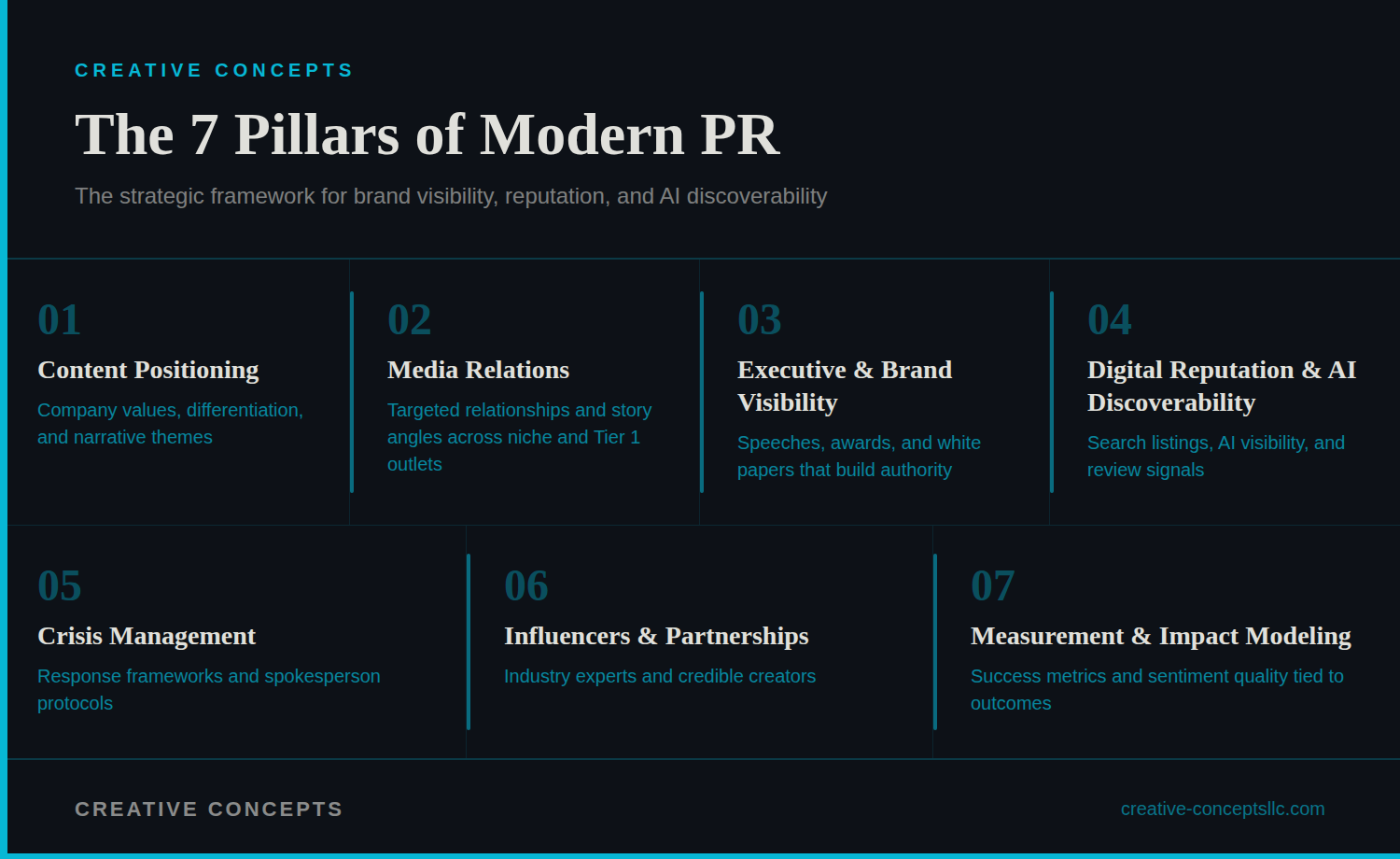
Creative Concepts, The 7 Pillars of Modern PR
What Are The 7 Pillars of Modern PR?
The seven pillars represent the full scope of what public relations must cover in 2026: content positioning, media relations, executive and brand visibility, digital reputation and AI discoverability, crisis management, influencers and partnerships, and measurement and impact modeling. Each pillar serves a distinct strategic function. Ignoring any one of them creates a gap that competitors will fill.
Pillar 1: Content Positioning
Content positioning is the foundation. It defines your company values, your differentiation, and your narrative themes before a single pitch goes out or a single post gets published. Without clear positioning, everything that follows is noise. The brands that show up consistently in AI-generated answers are the ones with a defined point of view that appears across multiple content types and platforms. Positioning is not a baseless exercise. It is the strategic backbone that determines whether your content gets cited or ignored.
Pillar 2: Media Relations
Media relations has not disappeared. It has become more targeted. A Seer Interactive analysis of 27 million AI-generated citations found that 97.4% of AI citations come from niche, trade, and specialist media. Only 2.6% come from Tier 1 outlets like Forbes or the Wall Street Journal. Both matter, but for different reasons. Niche media drives AI discovery. Tier 1 media validates credibility. A modern media strategy accounts for both tiers and builds pitch strategies accordingly. Building genuine relationships with journalists remains essential, especially as reporters now receive hundreds of AI-generated pitches weekly and can identify generic outreach immediately.
Pillar 3: Executive and Brand Visibility
The people behind a brand matter as much as the brand itself. Speeches, awards, white papers, and expert commentary build the kind of individual authority that AI engines evaluate when deciding who to cite. AI tools assess professionals the same way they assess brands. If your CEO or chief marketing officer has no published content, no speaking history, and no digital footprint beyond a LinkedIn profile, they are invisible to the systems that now shape public perception. Building executive visibility is not vanity. It is infrastructure.
Pillar 4: Digital Reputation and AI Discoverability
This is where the largest shift has occurred. AI visibility is a brand's ability to be accurately found and recommended by AI engines on platforms like ChatGPT, Perplexity, Claude, Gemini, and Google AI Overviews. SEO used to determine how brands were found online. AI visibility now determines whether brands are found at all.
The data is stark. When AI Overviews appear in a Google search, organic click-through rates drop by 61%. Around 93% of AI search sessions end without a website click. And only about 30% of brands remain visible in back-to-back AI responses for the same query. If AI does not cite your brand in an unbranded prompt, your product will not be considered. This is not a future scenario. It is the current operating environment.
The brands treating AI discoverability as an afterthought are already losing ground. Auditing how your brand appears in AI-generated responses, identifying where citations are missing, and building the authority signals that earn those citations is now a core PR function, not an optional add-on.
Pillar 5: Crisis Management
Viral content spreads in hours, not days. By the time traditional monitoring flags a threat, 54% of consumers have already formed a negative opinion about the brand in question. The response window that PR teams used to rely on has essentially collapsed.
Traditional monitoring tools fail because they rely on keyword matching, which misses euphemisms, coded language, and evolving slang. They deliver reports on weekly or monthly cycles, well after the damage window has closed. And they track volume and mentions without analyzing audience intent to boycott, switch, or take action.
That gap between when a threat emerges and when most brands respond is exactly what modern crisis tools need to close. AI BRAND DEFENSE™ by Creative Concepts was designed around this reality, using semantic and intent analysis to deliver counter-narrative guidance while the window to act is still open. Without that kind of speed, narratives harden into lasting reputation and revenue damage within 24 to 72 hours.
Pillar 6: Influencers and Partnerships
The influencer landscape has matured. The most effective partnerships in 2026 are not built on follower counts. They are built on credibility. Industry experts and subject-matter creators drive trust in ways that celebrity endorsements cannot replicate. Brands are moving from volume-based influencer strategies to value-based ones, partnering with creators who spark meaningful conversations and reflect shared values. PR professionals who understand how to identify and activate these partnerships create durable authority that feeds both human audiences and AI engines.
Pillar 7: Measurement and Impact Modeling
If you cannot prove the business impact of your PR program, you cannot defend the budget. That has always been true, but the metrics have changed. Success metrics now include share of AI-generated responses, citation frequency across AI platforms, sentiment quality, and the correlation between earned media placements and downstream revenue. 96% of communications teams now rely on data over intuition for decision-making. The PR function that cannot quantify its contribution to brand discovery, reputation defense, and pipeline influence will lose resources to functions that can.
How Do These Pillars Work Together?
No single pillar operates in isolation. Content positioning informs media relations. Media placements build the digital authority that AI engines use to determine citations. Crisis readiness protects the reputation that executive visibility and partnerships have built. And measurement ties every effort back to outcomes that matter to the C-suite. The brands that treat PR as a collection of disconnected tactics will continue to lose ground to competitors who treat it as an integrated system.
Frequently Asked Questions
What is AI visibility in public relations?
AI visibility refers to a brand's ability to be accurately found, cited, and recommended by AI-powered platforms like ChatGPT, Perplexity, Gemini, and Google AI Overviews. It is now a core function of modern PR strategy.
Why does niche media matter more for AI discovery?
Research shows that 97.4% of AI citations come from niche, trade, and specialist publications. These outlets provide the detailed, category-specific content that large language models prioritize when generating answers.
What is AI BRAND DEFENSE™?
AI BRAND DEFENSE™ is a proprietary crisis intelligence tool developed by Creative Concepts that monitors emerging threats using semantic and intent analysis, then delivers counter-narrative guidance within hours so brands can respond before a narrative becomes permanent.
How has crisis management changed in 2026?
The response window has collapsed from days to hours. Traditional keyword-based monitoring misses coded language and evolving slang. Modern crisis management requires real-time semantic monitoring and immediate counter-narrative strategy.
How should brands measure PR success in 2026?
Beyond traditional media impressions, brands should track share of AI-generated responses, citation frequency across AI platforms, sentiment quality, and the connection between earned media and business outcomes like revenue and customer acquisition.
Creative Concepts has operated at the intersection of digital marketing, brand strategy, and emerging technology for over 23 years. As AI reshapes how consumers discover and evaluate brands, these seven pillars provide the framework for PR programs that actually protect and grow market position.
Creative Concepts publishes ongoing analysis on AI visibility, crisis intelligence, and brand strategy through its Intelligence Briefings.
Sources:
Seer Interactive, AI citation analysis across ChatGPT, Perplexity, and Gemini
Conductor 2026 AI Search Benchmarks: https://www.conductor.com
PRLab, PR Industry Statistics 2026
Superlines, AI Search Statistics 2026
PR Week, How AI Will Change PR in 2026
Creative Concepts analysis of viral consumer brand threats, 2026